
Want to explore BaZi more deeply? Visit our BaZi guide hub for a complete introduction.
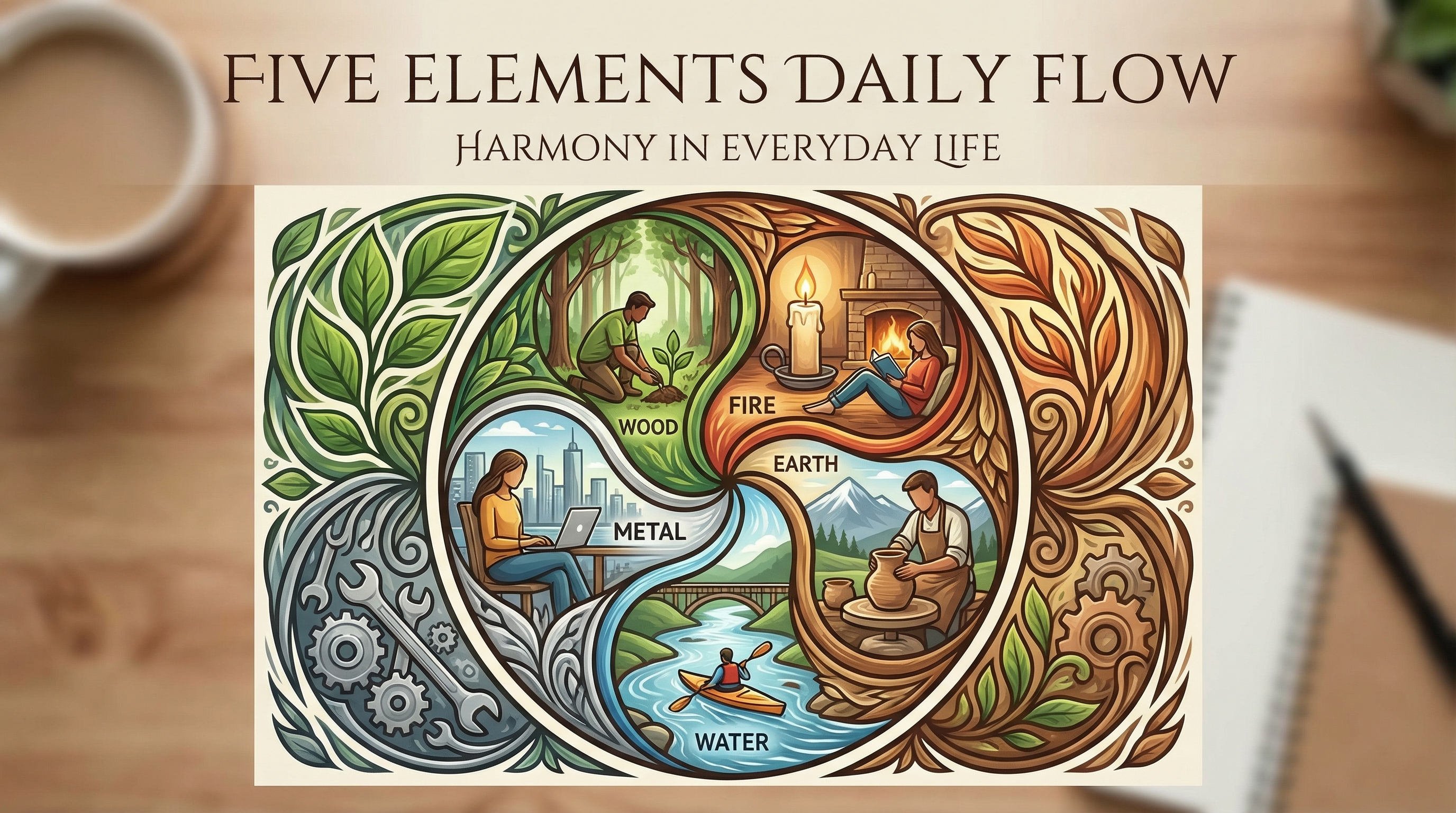
In BaZi, the Five Elements — Wood, Fire, Earth, Metal, and Water — are the basic language for reading chart structure and life themes as tendencies, not fixed outcomes. A free chart preview is a pillar entry point: four pillars with birth time, three without. It does not include Ten Gods, luck cycles, or Daily. Confirm your pillars with Get My Free Chart Preview, then use this page for how the elements are read.
These aren't just physical substances. In the Chinese worldview, they're living energies — patterns of movement that flow through everything in existence, including you. And in BaZi (八字) — the Four Pillars framework — the Five Elements form the entire language of analysis.
Your birth chart is essentially a map of how these five energies distribute across the four pillars of your life. Understanding the elements is understanding BaZi itself.
What Are the Five Elements (Wu Xing)?
The Chinese term is 五行 (Wu Xing) — literally "five movements" or "five phases." That's an important distinction. These aren't static categories. They're dynamic processes: ways that energy transforms, creates, and destroys.
Each element represents a phase in a natural cycle:
| Element | Phase | Season | Direction | Color |
|---|---|---|---|---|
| Wood (木) | Growth, expansion | Spring | East | Green |
| Fire (火) | Peak, radiance | Summer | South | Red |
| Earth (土) | Transition, stability | Late summer | Center | Yellow |
| Metal (金) | Contraction, refinement | Autumn | West | White |
| Water (水) | Storage, reflection | Winter | North | Black/Blue |
Think of them as chapters in nature's story: seeds germinate (Wood), bloom into full expression (Fire), bear fruit that returns to the ground (Earth), minerals condense and harden (Metal), and everything dissolves back into the deep reservoir that will nourish next year's seeds (Water).
The Two Fundamental Cycles
The Five Elements don't exist in isolation. They interact through two interlocking cycles that explain everything from weather patterns to human relationships.
The Generating Cycle (相生, Xiāng Shēng)
Each element naturally produces the next, forming a nurturing chain:
Wood → Fire → Earth → Metal → Water → Wood
- Wood feeds Fire — Wood burns, providing fuel for fire
- Fire creates Earth — Fire produces ash, which becomes soil
- Earth yields Metal — Ore and minerals form within the earth
- Metal collects Water — Metal surfaces cool and attract condensation
- Water nourishes Wood — Water feeds roots, allowing trees to grow
In human terms, the generating cycle describes support, nurturing, and natural flow. When an element in your chart generates the next one, energy moves smoothly. A parent supporting a child, a mentor empowering a student, an idea becoming reality — these all follow the generating cycle.
The Controlling Cycle (相克, Xiāng Kè)
Each element also restrains another, creating necessary boundaries:
Wood → Earth → Water → Fire → Metal → Wood
- Wood penetrates Earth — Tree roots break through soil
- Earth dams Water — Levees and dikes control floods
- Water extinguishes Fire — Water quenches flames
- Fire melts Metal — Heat softens and reshapes metal
- Metal chops Wood — An axe fells a tree
The controlling cycle isn't aggressive — it's regulatory. Without it, any element would grow unchecked and become destructive. Too much Water without Earth to contain it becomes a flood. Too much Fire without Water to temper it becomes a wildfire.
In BaZi, the controlling cycle explains conflict, challenge, discipline, and growth through resistance. A controlling element in your chart creates friction — but friction is often what shapes us into our best selves.
Deep Dive: Each Element's Personality
In BaZi, your Day Master — the Heavenly Stem of your Day Pillar — determines your primary element. But the distribution of all five elements across your entire chart creates the full picture.
Wood (木) — The Grower
Yang Wood (甲): The tall tree — upright, principled, reaching toward the sky. You have strong convictions and visible ambition. You don't bend easily.
Yin Wood (乙): The vine or grass — flexible, resilient, adaptable. You grow around obstacles rather than through them. Your strength is your ability to survive anything.
Personality traits: Kind, optimistic, growth-oriented, idealistic, sometimes stubborn. Wood people believe in progress and have difficulty accepting stagnation.
Strengths: Vision, compassion, planning, leadership through inspiration. You see what's possible and motivate others toward it.
Weaknesses: Inflexibility (Yang Wood), indecisiveness (Yin Wood), anger when growth is blocked. You can be naive about human nature.
Health areas: Liver, gallbladder, eyes, tendons, nervous system. When Wood is imbalanced, frustration and anger affect the liver first.
Career affinities: Education, publishing, forestry, agriculture, architecture, startups, non-profits, fashion (Yin Wood).
Relationship style: Nurturing but sometimes controlling. You want your partner to grow — sometimes in directions they didn't choose.
Fire (火) — The Illuminator
Yang Fire (丙): The sun — warm, generous, impossible to ignore. You light up every room. Your energy is expansive and inclusive.
Yin Fire (丁): The candle or lamp — focused, intense, illuminating specific things. Your light is directed and purposeful. You see what others miss.
Personality traits: Passionate, charismatic, expressive, impulsive, sometimes dramatic. Fire people live with intensity and struggle with boredom.
Strengths: Enthusiasm, leadership, creativity, ability to inspire. You make people feel alive.
Weaknesses: Burnout, impatience, emotional volatility, difficulty with sustained effort. Your flame can consume you as easily as it warms others.
Health areas: Heart, small intestine, blood circulation, tongue. When Fire is imbalanced, anxiety and insomnia appear first.
Career affinities: Entertainment, marketing, leadership, cooking, electrical engineering, psychology, spiritual guidance.
Relationship style: Passionate and devoted, but can be overwhelming. You love intensely and expect the same intensity returned.
Earth (土) — The Stabilizer
Yang Earth (戊): The mountain — massive, immovable, protective. You are the person everyone leans on. Your presence alone creates stability.
Yin Earth (己): The garden soil — nurturing, receptive, fertile. You absorb everything around you and transform it into something useful.
Personality traits: Reliable, trustworthy, patient, methodical, sometimes stubborn. Earth people are the foundation others build upon.
Strengths: Dependability, empathy, mediation, practical wisdom. You hold things together when everything else falls apart.
Weaknesses: Overthinking, worry, resistance to change, tendency to accumulate (possessions, weight, grudges). You can be too passive.
Health areas: Spleen, stomach, muscles, mouth. When Earth is imbalanced, digestive issues and excessive worry appear.
Career affinities: Real estate, agriculture, food industry, insurance, human resources, social work, construction, healthcare.
Relationship style: Loyal and committed, but sometimes possessive. You need security and struggle with partners who are too unpredictable.
Metal (金) — The Refiner
Yang Metal (庚): The sword or axe — sharp, decisive, powerful. You cut through complexity with clarity. You value justice and directness.
Yin Metal (辛): The jewel or precious metal — refined, beautiful, valuable. You have exquisite taste and high standards. Quality matters more than quantity.
Personality traits: Disciplined, principled, detail-oriented, sometimes rigid. Metal people value truth, structure, and excellence.
Strengths: Clarity, determination, analytical ability, integrity. When you commit to something, you see it through to completion.
Weaknesses: Rigidity, harshness (Yang Metal), vanity (Yin Metal), difficulty with emotional expression. You can seem cold even when you care deeply.
Health areas: Lungs, large intestine, skin, nose. When Metal is imbalanced, grief and respiratory issues appear first.
Career affinities: Law, finance, engineering, surgery, military, jewelry, technology, accounting, quality control.
Relationship style: Loyal but emotionally reserved. You show love through actions and structure rather than words and spontaneity.
Water (水) — The Philosopher
Yang Water (壬): The ocean or great river — powerful, deep, ambitious. You move with unstoppable force toward your goals. Your emotional life runs deep.
Yin Water (癸): The rain or dew — gentle, nourishing, perceptive. You reach places others can't. Your intuition is your greatest asset.
Personality traits: Intelligent, adaptable, philosophical, sometimes fearful. Water people see beneath surfaces and understand hidden currents.
Strengths: Wisdom, communication, flexibility, emotional intelligence. You read people and situations with remarkable accuracy.
Weaknesses: Indecision, fear, tendency to go with the flow when direction is needed. You can be too passive or too evasive.
Health areas: Kidneys, bladder, bones, ears. When Water is imbalanced, fear and fatigue appear first.
Career affinities: Shipping, logistics, communication, writing, counseling, intelligence, tourism, beverages, cleaning services.
Relationship style: Deeply emotional but sometimes elusive. You need a partner who can handle your depth without trying to drain you.
Element Distribution in Your Chart
Having a Wood Day Master doesn't mean you're "only Wood." Your complete BaZi chart contains eight characters, each carrying elemental energy. The overall distribution creates your elemental profile.
Dominant Element
When one element appears significantly more than others, it colors your entire personality and life experience. A chart dominated by Fire will produce an intensely passionate person regardless of their Day Master.
Missing Element
When an element is completely absent from your chart, that area of life requires conscious cultivation. A chart missing Water may indicate difficulty with emotional depth, wisdom, or flexibility — not because you can't develop these qualities, but because they don't come naturally.
Balanced Chart
Rare charts show a relatively even distribution across all five elements. These individuals are versatile and adaptable but may struggle with a lack of clear direction — when everything comes somewhat easily, it's harder to identify your calling.
Clashing Elements
When controlling-cycle elements are both strong in your chart (strong Wood and strong Metal, for example), internal tension drives your personality. This often produces high achievers who channel inner conflict into external accomplishment.
Elements in Relationships
The Five Elements explain relationship dynamics with remarkable precision. When two people's charts interact, the element relationships between their Day Masters — and their complete charts — reveal the natural dynamic:
- Generating relationship (相生): One person naturally supports the other. Feels nurturing but can become one-sided.
- Same element: Deep understanding but limited growth. You mirror each other.
- Controlling relationship (相克): Natural tension that creates attraction. Passionate but challenging.
- Weakening relationship: One person drains the other's energy. Requires awareness to manage.
For a deeper look at how elements affect romantic compatibility, see our BaZi love compatibility guide.
Elements Through the Seasons of Life
Your element balance isn't static. As you move through BaZi's Luck Cycles (大运), different elements become prominent in your life for 10-year periods. A decade dominated by Metal will feel very different from one dominated by Water — even for the same person.
This means:
- The career that suited you in your 20s may not suit you in your 40s
- Relationship dynamics shift as both partners enter different luck cycles
- Health vulnerabilities change as elemental emphasis shifts
Understanding your current luck cycle's element — and how it interacts with your natal chart — is one of the most practical applications of BaZi. It explains why some years feel effortless while others feel like pushing through mud.
To learn more about how these cycles unfold, explore our guide to reading your BaZi chart.
Working With Your Elements
The Five Elements aren't a life sentence. They're a map. Knowing your elemental makeup helps you:
- Lean into your strengths — Instead of fighting your nature, work with it
- Shore up your weaknesses — Consciously develop your missing or weak elements
- Time your decisions — Use luck cycles to know when conditions favor action vs. patience
- Improve relationships — Understand the elemental dynamic between you and your partner, boss, or friends
- Protect your health — Pay attention to the organ systems associated with your weak elements
BaZi's Five Elements aren't astrology in the Western sense. They're a practical framework for understanding how energy moves through your life — and how to move with it instead of against it.
Frequently Asked Questions
What are the Five Elements in BaZi?
The Five Elements (五行, Wu Xing) in BaZi are Wood (木), Fire (火), Earth (土), Metal (金), and Water (水). They are not static categories but dynamic phases of energy transformation. In a BaZi chart, these five elements distribute across your four pillars (Year, Month, Day, Hour) and their interactions — producing, controlling, and balancing each other — reveal your personality, health tendencies, career aptitudes, and relationship dynamics.
How do the Five Elements interact?
The Five Elements follow two primary cycles. The Generating Cycle (相生): Wood feeds Fire, Fire creates Earth (ash), Earth produces Metal (minerals), Metal collects Water (condensation), Water nourishes Wood. The Controlling Cycle (相克): Wood parts Earth, Earth dams Water, Water extinguishes Fire, Fire melts Metal, Metal chops Wood. A balanced chart has elements that both generate and control each other in healthy proportion.
Which Five Element am I in BaZi?
Your primary element in BaZi is determined by your Day Master — the Heavenly Stem of your Day Pillar. There are 10 possible Day Masters (Yang and Yin versions of each element): Yang Wood, Yin Wood, Yang Fire, Yin Fire, Yang Earth, Yin Earth, Yang Metal, Yin Metal, Yang Water, Yin Water. However, your full chart contains all five elements in varying proportions. A free BaZi reading will identify your Day Master element and show your complete elemental distribution.
Do I need all Five Elements in my BaZi chart?
Not necessarily. Very few people have all five elements present in their birth chart, and that's normal. What matters is the balance and interaction between the elements you do have. A chart with three strong elements can be excellent if they support each other well. The concept of "favorable" and "unfavorable" elements in your chart depends on what your Day Master needs — not on having all five present.
Discover Your Own BaZi Reading — Free
Curious which elements dominate your chart? Get your free BaZi reading →
Enter your birth date and see your Day Master, Five Elements distribution, and the four pillars that help you read chart patterns and tendencies. Discover which elements you have in abundance and which ones you need to cultivate.
What to Read Next
- The Five Elements: Which One Are You? — The foundational guide to Five Element theory
- Your Day Master: The Most Important Thing in Your Birth Chart — Discover your core elemental identity
- Five Element Wellness: How Your BaZi Chart Reveals Your Health Blueprint — Apply elemental wisdom to your health
- BaZi Love Compatibility: How the Five Elements Shape Your Relationships — See how elements interact in romance