
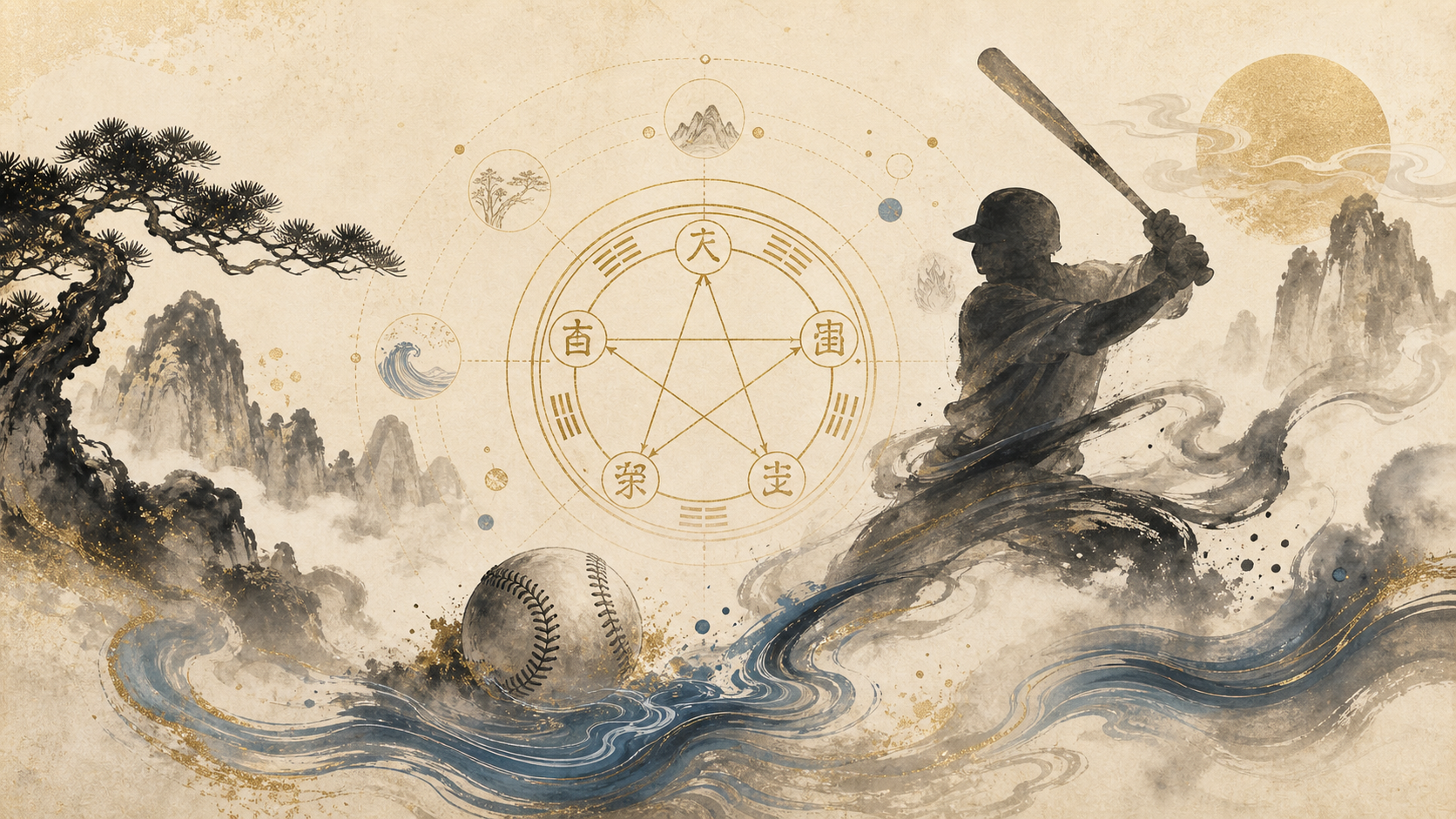
The most interesting thing about Ohtani's chart is how naturally it holds two systems at once. Pitching and hitting are not just two talents. They are two different rhythms, two different demands, and two different kinds of pressure moving through the same body.
MLB's official profile lists Ohtani's birth date as July 5, 1994. No public birth time is available, so the chart here stays with the three visible pillars. Even that limited chart shows a clear theme: Ren Water at the center, with Geng Horse placing technical refinement and public heat very close together.
That frames Ohtani's public career well. Pitching and hitting are not just two talents; they are two different rhythms that must pass through one body. Ren Water's flexibility, Geng Metal's training quality, and Horse Fire's visibility all help explain why his public story feels so unusual.
Public career record
MLB's official player profile records Shohei Ohtani as born on July 5, 1994 in Oshu, Japan, with his MLB debut on March 29, 2018. It also records his 2024 Dodgers season: 54 home runs, 59 stolen bases, the first 50-home-run and 50-steal season in MLB history, a World Series title, and the National League MVP award.
AP also reported that Ohtani's 2024 MVP win led Japanese newspapers to print special editions. That tells you something important: his public career is no longer only a baseball story. It is also a cultural story in Japan. The article keeps those layers separate. Facts stay factual. BaZi stays interpretive.
The three pillars
| Pillar | Gan-Zhi | Main Ten Gods from Ren Water | Reading axis |
|---|---|---|---|
| Year | Jia Dog | Jia is Eating God; Dog stores Seven Killings, Direct Resource, Direct Wealth | Expression, discipline, endurance |
| Month | Geng Horse | Geng is Indirect Resource; Horse stores Direct Wealth and Direct Officer | Technique, research, stage, responsibility |
| Day | Ren Dragon | Ren Water Day Master; Dragon stores Seven Killings, Hurting Officer, Rob Wealth | Large selfhood, pressure response, competitive drive |
Ohtani's month stem is Geng: metal, blade, and trained skill. For a Ren Water Day Master, Geng is Indirect Resource, which often points to specialized learning, unusual study methods, and a willingness to work outside ordinary assumptions.
The month branch is Horse. Horse is a strong fire branch. For Ren Water, fire is the Wealth star: not only money, but measurable output, public value, results, and attention. Geng Horse is a pillar where invisible training and visible achievement sit beside each other.
Ren Water: holding two streams at once
Ren Water is not a small cup of water. It is river, ocean, current, and scale. It adapts to the shape of the situation while moving across a large field.
For an athlete, this becomes the ability to perceive changing game states rather than a fixed role. At the plate, Ohtani reads the opposing pitcher. On the mound, he reads hitters and pitch sequences. Across a season, he has to manage a much longer rhythm of load, timing, and adjustment. Ren Water is not only about one pitch. It is about flow.
Ren Water alone does not create a two-way player. But the public career theme of integrating multiple roles fits this Day Master unusually well.
Geng Horse month: metal technique under public fire
Geng is metal that must be forged. It is not raw talent shown as-is; it is talent cut, sharpened, repeated, and turned into form. For Ren Water, Geng is Indirect Resource, so the reading leans toward specialized research, body awareness, and an unusual training logic rather than ordinary practice alone.
Horse is fire. Fire is light and public visibility. From Ren Water's perspective, fire is Wealth: the place where results become numbers. Home runs, RBIs, ERA, strikeouts, stolen bases, contracts, MVP awards. In professional sports, the Wealth star becomes very concrete.
The interest of Geng Horse is that quiet technical refinement and highly visible outcomes share the same pillar. That matches the public record: a large volume of measurable achievements sitting on top of an unusually demanding technical base.
Jia Dog year: expression inside a pressure vessel
The year stem Jia is Eating God for Ren Water. In the Ten Gods, Eating God represents natural output, expression, and talent flowing outward. In sports language, it is the quality that makes a performance feel natural to the viewer rather than merely forced.
But the Dog branch stores Wu Seven Killings, Xin Direct Resource, and Ding Direct Wealth. Seven Killings brings pressure, competition, and crisis response. Direct Resource brings support, learning, and protection. Direct Wealth brings concrete results and responsibility. This is not carefree expression; it is expression held inside a vessel of pressure.
Ohtani's public career has long been surrounded by the question of whether two-way play could work at the highest level. In chart terms, that looks like natural expression passing through pressure and support before it becomes public achievement.
Public news through the BaZi lens
In the 2023 World Baseball Classic, MLB's profile records Japan's championship and Ohtani's tournament MVP. In the chart, that looks like Ren Water's ability to move across roles and contexts showing up at the biggest possible scale.
The 2024 season is even more direct. In his first Dodgers season, Ohtani reached 50 home runs and 50 stolen bases, won the World Series, and became the unanimous National League MVP. Horse Fire as the Wealth star is where internal flow becomes visible achievement: numbers, awards, and public value.
AP's report on Japanese newspapers printing special editions adds another layer: performance turning into a shared cultural moment. The Jia Eating God year pillar helps explain why the story is so easy to transmit. Sports news becomes cultural news when expression reaches beyond the field.
Further reading
Related guides: Ren Water, the Ten Gods guide, how to read a BaZi chart, and the free BaZi reading.
Summary
Shohei Ohtani's three pillars place Ren Water at the center, with Geng Horse's technical refinement and public fire, plus Jia Dog's expression under pressure. The pattern is a strong fit for his public story: Ren Water integrates multiple streams, Geng Metal sharpens technique, and Horse Fire makes results visible.