
Want a complete introduction to BaZi? Visit our BaZi guide hub.
In Chinese conversation, you may hear people say “look at your BaZi,” “this person has a strong BaZi,” or “their BaZi do not match.” The system also appears in practices around naming, marriage, choosing dates, and moving home.
So what is BaZi? This five-minute introduction covers how the chart is built, what its main parts mean, and what readers look for.
What is BaZi?
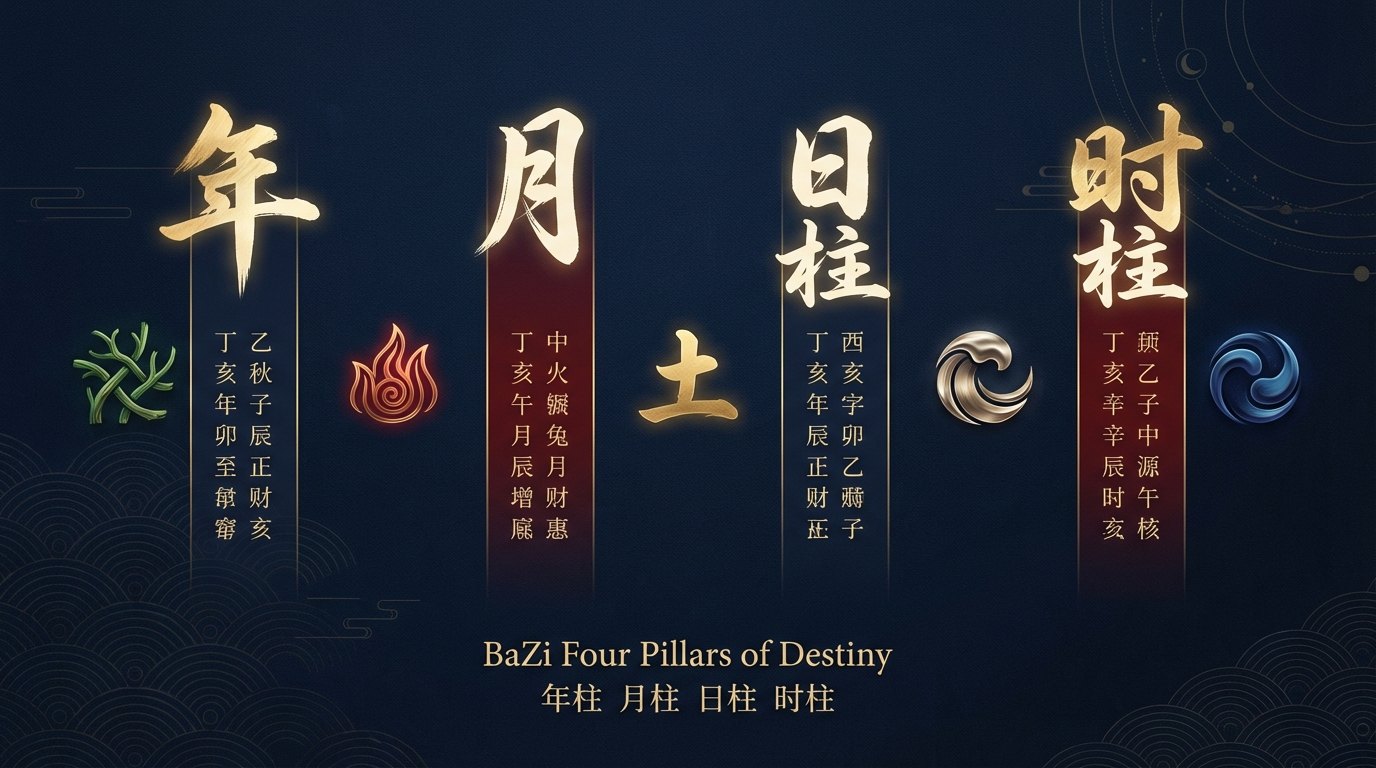
BaZi, formally called Four Pillars BaZi (四柱八字) or Four Pillars life analysis (四柱命理), uses the year, month, day, and hour of birth. Each pillar contains one Heavenly Stem and one Earthly Branch. Four pillars with two characters each produce eight characters.
That is where the name BaZi, or “eight characters,” comes from: four pillars × two characters per pillar = eight characters.
| Pillar | What it represents | Areas it relates to |
|---|---|---|
| Year Pillar | Ancestors, roots, public image | Family background, early years, other people's first impression of you |
| Month Pillar | Career, parents, upbringing | Career direction, relationships with elders, ages 25–50 |
| Day Pillar | Self and spouse | Your most natural character and marital relationships |
| Hour Pillar | Children, later years, inner world | Subconscious wishes, children, and life after age 50 |
Together, the four pillars form a complete 命式 (meishiki), or BaZi chart. The chart records the stem-and-branch pattern assigned to the time of birth.
Heavenly Stems and Earthly Branches: BaZi's time system
BaZi organizes time through the Heavenly Stems and Earthly Branches (天干地支), often shortened to “stems and branches.” This system developed in ancient China.
The Ten Heavenly Stems
There are ten Heavenly Stems, pairing the Five Elements with Yin and Yang:
| Heavenly Stem | Element | Yin/Yang | Image |
|---|---|---|---|
| 甲 | Wood | Yang | A great tree; upright and growing |
| 乙 | Wood | Yin | A vine; resilient and flexible |
| 丙 | Fire | Yang | The sun; passionate and bright |
| 丁 | Fire | Yin | Candlelight; focused and subtle |
| 戊 | Earth | Yang | A mountain; steady and reliable |
| 己 | Earth | Yin | A garden; receptive and nurturing |
| 庚 | Metal | Yang | A sword; decisive and resolute |
| 辛 | Metal | Yin | Jewelry; refined and exacting |
| 壬 | Water | Yang | The ocean; deep and powerful |
| 癸 | Water | Yin | Fine rain; sensitive and gentle |
The Twelve Earthly Branches
There are twelve Earthly Branches, corresponding to the familiar Chinese zodiac animals:
子 (Rat), 丑 (Ox), 寅 (Tiger), 卯 (Rabbit), 辰 (Dragon), 巳 (Snake), 午 (Horse), 未 (Goat), 申 (Monkey), 酉 (Rooster), 戌 (Dog), 亥 (Pig)
Each Earthly Branch also contains one to three hidden Heavenly Stems, known as hidden stems (藏干) or hidden roots (地支藏元). A full reading includes these stems, not just the branch's zodiac animal.
The sixty stem-branch combinations
Pairing the Ten Heavenly Stems and Twelve Earthly Branches in sequence creates 60 combinations, called the sexagenary cycle (六十甲子). Each pillar uses one of them.
The total number of four-pillar combinations is: 60 × 60 × 60 × 60 = 12,960,000
That produces nearly 13 million theoretical four-pillar patterns. By comparison, Western sun signs and Chinese zodiac animals each use 12 categories.
Day Master: who are you?
The central reference point in a BaZi chart is the Heavenly Stem of the Day Pillar. It is called the Day Master (日主), Day Origin (日元), or Day Stem (日干).
The Day Master represents the person whose chart is being read. Readers use it to discuss basic temperament, outlook, and instinctive responses.
For example:
- 甲 Wood is associated with the upright growth of a large tree and with firm principles
- 丙 Fire uses the sun as its image and is associated with warmth, generosity, and leadership
- 庚 Metal uses the sword as its image and is associated with decisiveness and fairness
The rest of the chart is read in relation to the Day Master. That includes the other stems and branches, the Five Elements distribution, and the Ten Gods relationships.
Want a detailed look at all ten Day Masters? Read our complete Day Master guide.
The Five Elements: the basis of BaZi analysis
The Five Elements are Wood, Fire, Earth, Metal, and Water. Every Heavenly Stem and Earthly Branch in the eight characters belongs to one of them.
The generating cycle
In the generating cycle, each element feeds the next:
- Wood generates Fire (wood burns to create fire)
- Fire generates Earth (fire leaves ash that becomes earth)
- Earth generates Metal (ore is held within the earth)
- Metal generates Water (water droplets condense on metal)
- Water generates Wood (water nourishes trees)
The controlling cycle
The Five Elements also regulate one another:
- Wood controls Earth (roots penetrate soil)
- Earth controls Water (a dam holds back water)
- Water controls Fire (water extinguishes flame)
- Fire controls Metal (fire melts metal)
- Metal controls Wood (an axe cuts wood)
Readers examine which Five Elements are prominent, scarce, or evenly distributed:
- An abundant element: Its associated qualities can stand out. Abundant Fire, for example, is linked with enthusiasm and boldness, as well as impatience.
- A weaker element: Its associated qualities may need more attention. A reader might connect little Water with communication or emotional expression.
- Balanced elements: A more even distribution is associated with adaptability, though it may produce fewer sharply defined traits.
To explore how the Five Elements relate to character, read our Five Elements guide.
What can BaZi tell you?
A traditional BaZi reading can cover several parts of life:
1. Character and natural abilities
The Day Master and Five Elements distribution provide the starting point for discussing temperament and natural abilities.
2. Career direction
Readers connect the Month Pillar with the work environment. They consider it alongside the Day Master and Ten Gods, including Direct Officer, Seven Killings, Direct Wealth, and Indirect Wealth, when discussing work and industry fit.
3. Marriage and relationships
The Earthly Branch of the Day Pillar is called the spouse palace. Traditional readings connect it with marriage and partner preferences. They also treat Direct Wealth for men and Direct Officer for women as spouse stars when discussing relationships.
4. Finances
The strength and position of the Direct and Indirect Wealth stars are used to discuss a person's approach to money, such as steady accumulation or comfort with investment risk.
5. Health tendencies
The Five Elements correspond to organ systems in traditional Chinese medicine:
- Wood → liver and gallbladder
- Fire → heart and small intestine
- Earth → spleen and stomach
- Metal → lungs and large intestine
- Water → kidneys and bladder
In traditional interpretation, organ systems associated with elements that are weak or heavily controlled may be treated as areas to watch. This symbolic correspondence is not a medical diagnosis.
6. Luck cycles and annual cycles
BaZi also uses luck cycles (大運) of about ten years. Readers combine them with the annual cycle (流年) to discuss changes in timing and circumstances.
BaZi vs. Western sun signs: why is BaZi more detailed?
Many people follow both Western astrology and BaZi. How do the two differ?
| Dimension | Western sun signs | BaZi |
|---|---|---|
| Birth data used | Birth month (Sun sign) | Year, month, day, and hour pillars |
| Number of categories | 12 | Nearly 13 million theoretical combinations |
| Core identity | Sun sign | Day Master (Day Pillar's Heavenly Stem) |
| Time precision | Roughly 30 days per sign | One Chinese hour covers about two clock hours |
| Timing system | Transits and progressions | Ten-year luck cycles + annual cycles |
| Philosophical basis | Celestial movement and constellation mythology | Yin and Yang, Five Elements, Heavenly Stems, and Earthly Branches |
The comparison is about structure, not whether one system is more valid. BaZi uses more birth-data points and finer time divisions, so it sorts charts into more possible combinations.
What information do you need for a BaZi chart?
To generate a BaZi chart, prepare:
- Birth year, used to determine the Year Pillar
- Birth month; BaZi months follow solar terms rather than lunar-month dates
- Birth date, used to determine the Day Pillar
- Birth time, ideally accurate to within two hours
Birth time determines the Hour Pillar. Without it, one quarter of the four-pillar structure is unavailable, including the areas traditionally associated with children, later years, and the inner world.
If you do not know the exact time, the Year, Month, and Day Pillars still form a three-pillar chart. It shows the Day Master and broad Five Elements pattern, but not the Hour Pillar.
Frequently asked questions
Is BaZi fortune-telling accurate?
BaZi is a system for interpreting a chart, not a guarantee of what will happen. It describes patterns and tendencies. Choices, effort, family, and environment also shape a person's life.
Can BaZi change my fate?
The BaZi chart itself does not change because it records the time of birth. A reading can give you another way to consider your habits and prepare for difficult periods, but it does not fix the outcome.
Do people born in the same Chinese hour have the same life?
No. People with the same eight characters may share chart patterns, but family, environment, and personal choices can produce very different lives.
Do I need to know my lunar-calendar birthday?
No. Modern BaZi chart tools can convert a Gregorian date and calculate the chart automatically. You only need your Gregorian birth year, month, date, and time.
Before you read your chart
On a chart, find the Day Master first. Then look across the four pillars and note how the Five Elements are distributed. Those two steps give you a practical place to begin.
Get a free BaZi chart preview
To see your own Four Pillars and eight characters, Get My Free Chart Preview
The free chart preview displays four pillars when your birth time is known, or three pillars when it is not. It includes the Day Master and Five Elements for basic orientation. It does not include Ten Gods, luck cycles (大運), or Daily.